PDL Group
  • HOME
  • SECTORS
  • OUR EXPERTISE
  • CASE STUDIES
  • ABOUT US
  • Contact
  • Menu
Back

SUBSEA UMBILICAL — HEATING AND COOLING CYCLES OPTIMISED TO EXTEND SERVICE LIFE

  • LONGER SERVICE LIFE
  • MORE RELIABLE PERFORMANCE
  • SCRIPTS IMPROVED EFFICIENCY

SUMMARY

We supported our client by carrying out complex thermal analyses on production control umbilicals, designed for the Moho Nord Project. Our client wished to understand the effects of the venting of a particular gas through a casing vent line at both low and high temperature and how this might affect the other sensitive components of the umbilical. The results pinpointed some adverse effects when venting for extended periods. We developed an optimum heating and cooling duty cycle driving the operational envelope of the umbilical to mitigate these effects.

SITUATION

We worked with our client, a globally renowned, manufacturer of subsea power cables and umbilicals for the Oil & Gas and Renewable industries. We supported the team carrying out complex thermal analyses on production control umbilicals designed for the Moho Nord project off the West coast of Africa. Total’s Moho Nord project is a deepwater exploration and production development and is the largest oil project ever undertaken in the Republic of the Congo. Our client approached us because of our extensive experience and capability in carrying out transient thermal analyses.

CHALLENGE

For this particular project, the client required the venting of a particular gas through a casing vent line at both low (-50 degrees Celsius) and high temperature (85 degrees Celsius). They were interested in understanding how this high and low-temperature venting would affect the temperature of other sensitive components of the umbilical. This understanding, through the use of transient thermal assessments, would indicate potential failure points and areas susceptible to thermal ratcheting.  The risk of thermal ratcheting could then be mitigated by venting for certain durations and at specific intervals during operation; we would test these during the modelling work.

SOLUTION

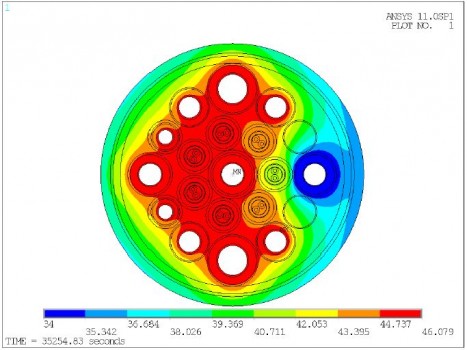
For both high and low temperature venting an initial steady state thermal assessment was carried out to obtain the umbilical operating temperature without the venting temperatures. We used these thermal profiles as the initial temperature distribution for the transient analyses. For the high and low-temperature venting, the casing line temperature was rapidly increased to 85 degrees Celsius and to -50 degrees Celsius respectively. The temperatures were held there for a specified period and then ramped down to 34 degrees Celsius for hot venting and up to 19 degrees Celsius for cold venting and allowed to cool and heat respectively for a given time period. This heating and cooling were repeated nine times to assess the propensity for thermal ratcheting which could increase the vulnerability of the umbilical to the effects of thermally induced fatigue. The results pinpointed particular hoses that were adversely affected by venting for long periods and allowed for an optimum heating and cooling duty cycle to be developed. All analyses were carried out in 2D using ANSYS APDL input decks to automate post-processing procedures.

BENEFITS

  • More reliable performance and hence decreased risk.
  • Longer service life and hence reduced cost.
  • Analysis inputs and outputs driven by ANSYS APDL scripts to increase the speed and efficiency of post-processing and reporting
  • Oil and Gas Field with flowlines and Umbilicals

    Subsea Umbilical Image
  • Umbilical

    Subsea Umbilical Picture
  • Cold Venting Temperature Distribution Steady State Analysis

    Subsea Umbilical Drawing
  • 2D Cross Section of Simplified Umbilical

    Subsea Umbilical Drawing
  • Thermal Distribution of Umbilical at 35254.83 seconds

PreviousNext
12345

SECTOR

Oil & Gas

PROJECT ATTRIBUTES

Finite Element Analysis

ANSYS Parametric Design
Language (APDL)
Transient Thermal Analysis
Thermal Ratcheting
Umbilicals

SCRIPTS INCREASED THE SPEED AND EFFICIENCY OF POST PROCESSING AND REPORTING

PDL CAN DELIVER FOR YOU

We’ve delivered over 1,500 successfully completed projects. If you’re working on a safety critical project or complex engineering challenge and need a technical solution, our engineering experts can help.

SPEAK TO US

EUROPE

1 Tanners Yard, Hexham, Northumberland, NE46 3NL

+44 (0) 1434 609 473

solutions@pdl-group.com

  • Cookie Policy
  • PDL Solutions FTP Site
  • Privacy Policy
  • Terms & Conditions
  • Terms of Use
  • +44 (0) 1434 609 473
THE ENGINEERING ANALYSIS EXPERTS Copyright © 2020-2023 PDL Solutions
  • LinkedIn
  • Twitter
  • Youtube
THERMAL OXIDE REPROCESSING PLANT (THORP) COOLING PONDS — CFD SIMULATION Case Studies - Thermal Oxide An image of amphibious vehicles on the sea STRUCTURAL ANALYSIS AND VALIDATED UPGRADES TO LCVP FOR LIFTING OPERATIONS
Scroll to top

This website uses cookies to ensure you get the best experience on our website

Got itOpt outSettings

Cookie and Privacy Settings


How we use cookies

We may request cookies to be set on your device. We use cookies to let us know when you visit our websites, how you interact with us, to enrich your user experience, and to customize your relationship with our website.

Click on the different category headings to find out more. You can also change some of your preferences. Note that blocking some types of cookies may impact your experience on our websites and the services we are able to offer.

Essential Website Cookies

These cookies are strictly necessary to provide you with services available through our website and to use some of its features.

Because these cookies are strictly necessary to deliver the website, refuseing them will have impact how our site functions. You always can block or delete cookies by changing your browser settings and force blocking all cookies on this website. But this will always prompt you to accept/refuse cookies when revisiting our site.

We fully respect if you want to refuse cookies but to avoid asking you again and again kindly allow us to store a cookie for that. You are free to opt out any time or opt in for other cookies to get a better experience. If you refuse cookies we will remove all set cookies in our domain.

We provide you with a list of stored cookies on your computer in our domain so you can check what we stored. Due to security reasons we are not able to show or modify cookies from other domains. You can check these in your browser security settings.

Google Analytics Cookies

These cookies collect information that is used either in aggregate form to help us understand how our website is being used or how effective our marketing campaigns are, or to help us customize our website and application for you in order to enhance your experience.

If you do not want that we track your visist to our site you can disable tracking in your browser here:

Other external services

We also use different external services like Google Webfonts, Google Maps, and external Video providers. Since these providers may collect personal data like your IP address we allow you to block them here. Please be aware that this might heavily reduce the functionality and appearance of our site. Changes will take effect once you reload the page.

Google Webfont Settings:

Google Map Settings:

Google reCaptcha Settings:

Vimeo and Youtube video embeds:

Privacy Policy

You can read about our cookies and privacy settings in detail on our Privacy Policy Page.

Privacy Policy
Accept settingsHide notification only