
Floating Wind Mooring Chain Inclinometer Cable Structural Integrity
SUMMARY
Global assessment of inclinometer power cable subject to dynamic mooring movement and hydrodynamic loading.
SITUATION
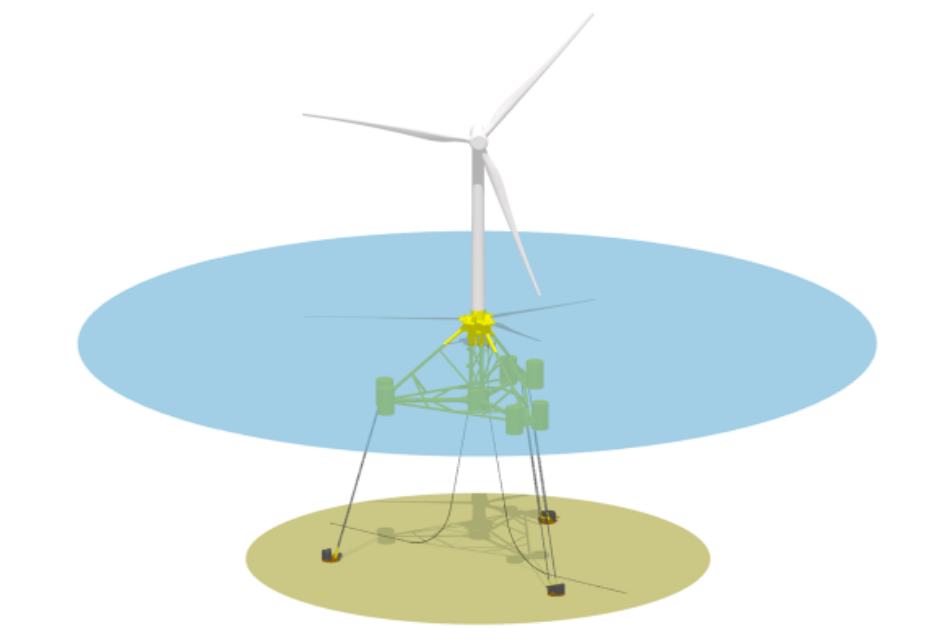
In southern Europe there is now a growing interest in floating wind, particularly for water depths in the region of 50m to 1000m. France’s first floating wind pilot project ‘Provence Grand Large’ will employ three nominally 8MW turbines each supported by a tri-pod semi-submersible platform in up to 100m water depth. The wind farm is located 17 km off Port Saint Louis du Rhone off Frances’ southern coast.
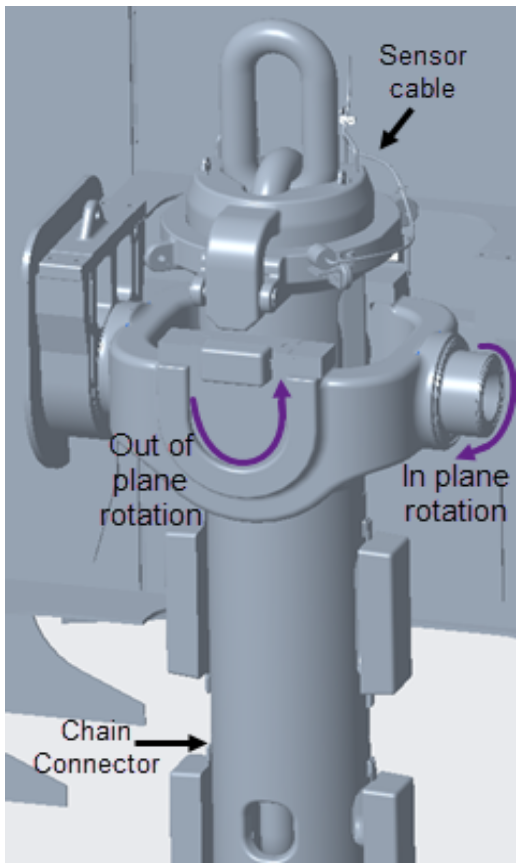
Each corner of the semisubmersible platform is constrained by a pair of mooring chains fixed to the seabed. The chain connectors can rotate about two axes at their upper ends and are fitted with inclinometers so that the rotation angle(s) can be measured. The inclinometer sensor cables have a complex routing and must be able to cope with the maximum in-plane and out-of-plane angles the chain connectors may take up, relative to the platform, in the full range of environmental conditions and maintenance/transport configurations.
PDL was contracted by the inclinometer cable supplier to undertake structural integrity assessments for the key cable components under ultimate limit state (ULS) and fatigue limit state (FLS) conditions.
CHALLENGE
Due to the angles the mooring chains take up during operation and transit, the proposed cable must be suitability mounted to be compliant, without becoming taut, exceeding it minimum bend radius or failing due to fatigue.
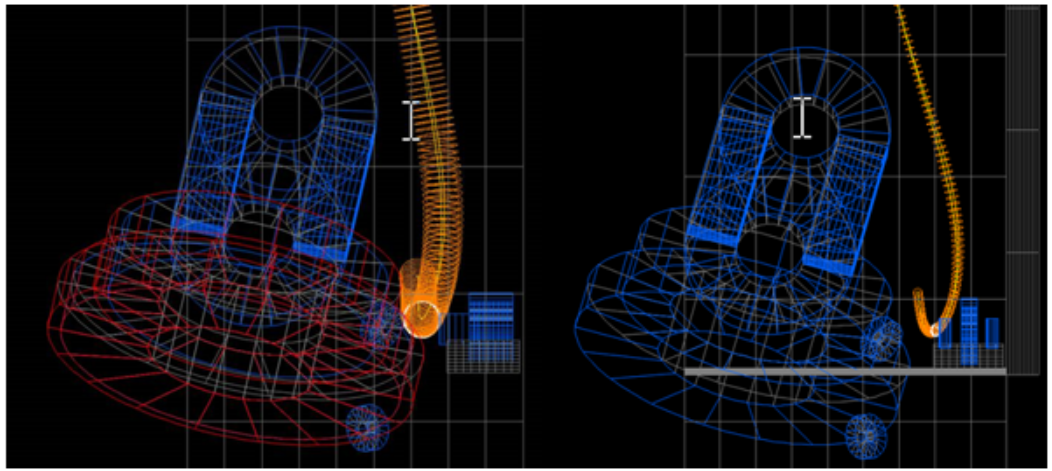
Contact between the cable sheath and the surrounding structure also needed to be accurately predicted as exposed bolt threads and pinch points could damage the cable.
SOLUTION
To develop a dynamic model of the sensor cable and chain connectors, global dynamic analysis software OrcaFlex was used.
PDL used an internal toolset to estimate the non-linear ‘stick-slip’ bending behaviour of the helically wound armour wires. As the behaviour is hysteretic, accurately capturing the stiffness of the cable in both the rigid ‘stick’ and more flexible ‘slip’ regions was critical to realistically predicting the movement of the cable due to the chain block movements.
The tool also calculates the fatigue life of the cable, taking into account the similar non-linear stress transfer functions.
Through python posting scripts, a series of goal seek simulations where run, taking into account such parameters as operating angles, marine growth, cable end angle and length to find an optimised cable route. The desired route was one that best suited the limitations of the cable within the 3D space governed by the two articulations and provided a suitable fatigue life.
Bend stiffeners at the end locations where also specified to reduce the loading into the sensor equipment – these had to be bespoke to each clamp.
BENEFITS
- Reduce risk: Accurately predict fatigue life of cable to ensure no loss of function due to cable failure while operational.
- Reduce cost: Working with the cable supplier to optimise the grade and thickness of armour wires used, cable routing and lengths between clamps and clamp bend stiffeners.
- Liaise with the FLOAT manufacturer, inclinometer equipment provider to ensure the final cable routing design worked for each party.
SECTOR
NICHE CAPABILITIES
OrcaFlex
Non-linear Cable Behaviour
METHODOLOGIES
Ultimate Limit State (ULS)
Fatigue Limit State (FLS)
RELEVANT CODES
Manufacturers specifications
ANALYSIS TOOLSET
OrcaFlex
Python
PDL CAN DELIVER FOR YOU
We’ve delivered over 1,500 successfully completed projects. If you’re working on a safety critical project or complex engineering challenge and need a technical solution, our engineering experts can help.

